Biochemistry of wool
Now, usually I have a more-than-comfortable amount of knowledge about a topic I write about before I decide to write about it. The biochemical makeup of wool and its impacts on farm production, however, were not one of those topics. Most of my career has been spent on UK farms where wool is often thrown in a hole, or on sheep milking farms where it’s just something that gets in the way. I have worked with a few Romney flocks where the farmers cared about their wool, but in my first few years in New Zealand, there was just so much else to take in.
At neXtgen Agri, I’ve spent the past four years working with breeding values and learning the ins and outs of how to manage merinos, but I hadn’t made time to really understand wool itself (at the depth that I like to understand things!) However, now that I’m based in the South Island and surrounded by merinos, that needs to change. And to be honest, I want to get my head around it.
If you’ve ever met me, you’ll know that I ask a lot of questions. I like getting to the root of things, and I think there’s something extremely satisfying about digging deeper and piecing together a ‘farming puzzle’ until there are no more questions to ask. I enjoy getting into the nitty gritty details because, for me, understanding each small part helps me see the whole picture more clearly. But when it comes to wool, I’ve never quite done that. And now I catch myself looking at wool and wondering why it crimps that way, what gives it its strength, and how those tiny fibres actually affect the feel and performance of a fleece.
So, here we are today, with me writing this article. I’ve thrown myself down the rabbit hole, and you’re welcome to join me. Below are a few things I found interesting when I looked into the biological makeup of wool and how that could impact production decisions. I hope you enjoy!
Wool follicle development
I thought I would begin here, as these are the biological 'factories' where fibres develop. Understanding how they form helped me understand why the fibre ends up with the structure it does, and now, having looked into them, I think they’re pretty cool!
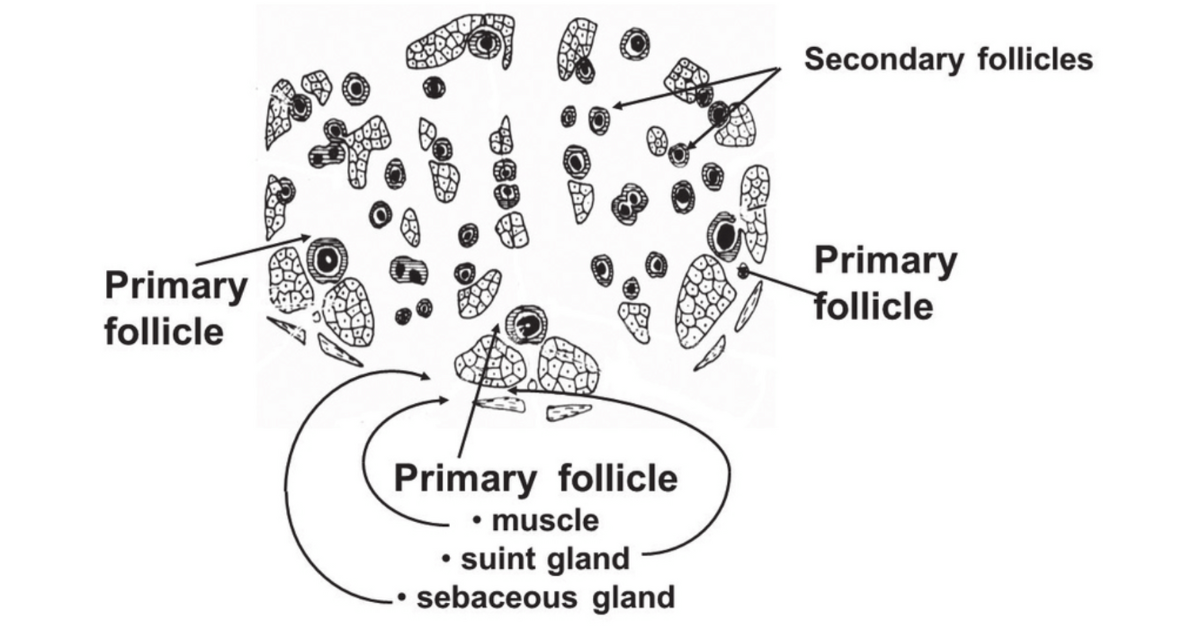
Figure 1. Transverse section of sheep skin showing the typical pattern of primary follicles and secondary follicles (Doyle et al. 2021, fig. 1).
As illustrated in Figure 1, wool follicles develop in clusters, known as follicle groups. They are comprised of the following:
Primary follicle (P): These are the first to develop at around day 70 of gestation. They sit deeper in the skin and are larger than other follicles. They also have extra bells and whistles, such as oil and sweat glands and a tiny muscle that makes the wool stand up (called the arrector pili).
Secondary original follicles (So): These begin forming around day 85 of gestation and continue developing after the lamb is born, until about 18 weeks. They often cluster around the P follicle in a defined pattern. They are smaller, shallower and do not have any accessory structures. However, So follicles are important because of their role as the origin point for secondary-derived follicles (SD). The physical location and orientation of the So follicles act as a template, influencing how many SD follicles will form. A higher density of So follicles around the P follicle provides more sites for SD follicle formation, resulting in a higher density of finer fibres emerging from the skin. Their spatial arrangement determines fleece characteristics such as fineness, uniformity and density.
Secondary-derived follicles (SD): These begin forming around day 105 of gestation. Much like So follicles, they continue to develop after the lamb is born, until about 18 weeks. SD follicles branch off from the So follicles within the same pore. Unlike human hair, where typically only one hair emerges per follicle, sheep can produce multiple fibres from a single follicle pore due to the branching nature of SD follicles. When multiple fibres emerge from one single follicle group, it means that each individual fibre is finer (as there is less 'space'). Fine-wool sheep have typically been bred to have between five and eight fibres, whereas strong-wool breeds usually have between two and four.
These three follicle types - and how they develop in utero - set the foundation for the lamb's fleece for life. While most of it is determined by genetics, it can also be affected by the nutrition, stress and oxygen levels of the ewe during pregnancy, especially between days 60-90, when follicle initiation takes place. This is when the skin cells are first triggered to start forming the initial follicle buds, beginning the process of follicle development in the fetus.
Follicle development is an energy-intensive and highly regulated process requiring adequate amounts of glucose, amino acids, fatty acids and micronutrients (like zinc, copper and iodine). If the ewe is underfed, the developing lamb diverts these resources back to critical organs, and follicle development gets downgraded in importance (or stops altogether). This is also why multiple-born lambs can have coarser wool. The placenta has to split the same amount of nutrients between multiple lambs, limiting the resources required for both organ and follicle development, which results in fewer SD follicles, meaning coarser wool.
The biochemical makeup of wool
Below is an illustration of the major wool fibre components (Figure 2). While I don't think every farmer needs to dive deep into the biochemistry of wool, I do think it’s good to have some concept of what’s involved in growing a fleece.
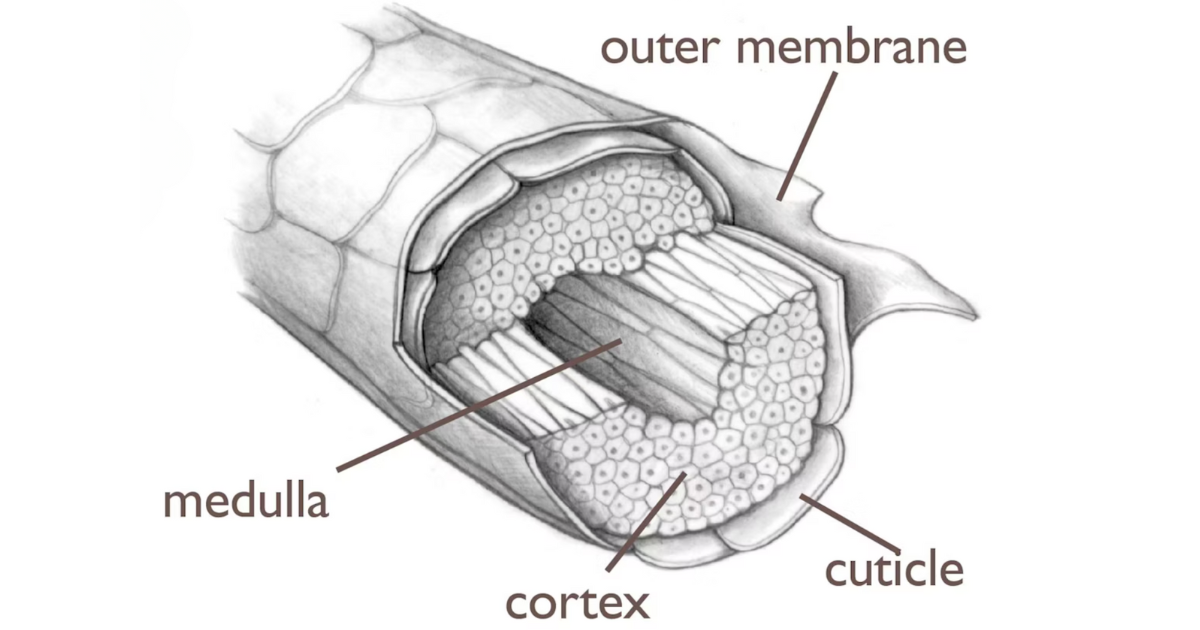
Figure 2. A cross-section of wool fibre, showing the medulla, cortex, cuticle and outer membrane. (Lalomia, 2020).
Wool fibres are primarily composed of keratin, which isn’t just a single protein but a mix of related proteins working together at the same time. Variations in this mix are what influence different wool characteristics. Each part of a wool fibre is made up of similar basic building blocks, but arranged and connected in distinctly different ways that come together to form a complete fibre. These consist of the:
Medulla (where present)
Orthocortex and paracortex, made up of keratin intermediate filaments (IFs) and keratin-associated proteins (KAPs)
Cell membrane complex
Cuticle
Medulla
We’ll start with the medulla as this is at the core … sometimes! Unlike other components of wool fibre, which vary on a scale, depending on how much of a certain cell type or protein is present, the medulla is more of an all-or-nothing feature. It’s either there or it’s not. It is not often found in merino wool - in fact, it’s been bred out of the breed intentionally.
When it’s present, the medulla runs down the centre of the fibre like a hollow core and doesn’t have any of the flexibility of the keratin intermediate filaments (IFs) and keratin-associated proteins (KAPs) mentioned below. The medulla actually interrupts the structure of IFs and KAPs, creating more weak points or areas where the fibre is less dense and less uniform, hence why we don’t like it in merino fleeces.
The medullation in a fleece is mainly determined by genetics, but conditions during gestation, along with environmental factors once a lamb is born, also have an impact. Typically, fine-wool sheep will have 0-5% medullation, whereas strong-wool breeds will sit around 20-40%.
One of the most important environmental influences on medullation is increased protein intake. If primary follicles have the genetic propensity to produce medullated fibres, higher protein availability will boost the activity of these follicles. In strong-wool breeds, high protein diets have been shown to increase medullation quite dramatically, as they have larger, more 'active' primary follicles that readily form medulated fibres. Comparably, in fine-wool breeds, the follicles generally lack the genetic programming to produce medulated fibres, even with a higher protein intake. It still affects them, just not as much.
Orthocortex and paracortex cells
The orthocortex and paracortex are a pretty cool pair of cells that either wrap around the medulla or each other, forming the entire cortex, and they are what determines the crimp of a wool fibre. The chemical bond joining these two very different cell types side by side creates a push-pull effect and is what causes the fibre to crimp.
The keratin proteins involved in the cortex are:
Keratin intermediate filaments (IFs)
These are the framework of wool fibres, and they form the long, thread-like strands inside the fibre. The proteins twist into spiral shapes and join together to form thin strands about 7 to 10 nanometres wide (that’s about 10,000 times smaller than the width of a human hair!).
In strong-wool breeds, the keratin IFs tend to assemble into thicker, less flexible strands, due to having more of certain building blocks (hydrophobic amino acids and cysteine, if you were interested) that act like a chemical glue. These bonds make stiffer and stronger filaments.
In fine-wool breeds, these filaments are thinner and more flexible because the building blocks are arranged differently. Fine wool has less 'glue', or the glue is in the 'wrong' place, resulting in fewer strong bonds holding the filaments together, allowing them to bend and stretch more easily.
Keratin-associated proteins (KAPs)
These are sulphur-rich proteins that surround the IFs, forming a matrix that cements all of the filaments together like a glue. As you may have assumed, the make-up of the matrix is different in strong-wool and fine-wool breeds. In strong-wool breeds, the matrix is dense and cross-linked with lots of little 'bridges' formed by disulphide bonds. In fine-wool sheep, there are fewer 'bridges' and the network is far less dense, and they have more of a specific type of KAP that enhances elasticity and crimp.
The orthocortical keratins are softer and more flexible, and have fewer of the 'bridges' we mentioned above. Paracortical keratins have a higher sulphur content and, because of that, they have more disulphide bonds - aka, bridges! Making them stiffer and tougher than orthocortical keratins. They also respond differently to temperature and hydration changes, too. This causes uneven expansion, contraction and elongation along the fibre, which results in a crimp! The distribution, number and properties of these cells are primarily controlled by genetics, and most of this happens within the wool follicle. However, environmental effects and management practices can also affect crimp. Things like poor nutrition will result in poor follicle health, and the same goes for health or environmental stresses.
Cell membrane complex
The cell membrane complex (or CMC) is found between the cortical cells and the cuticle, holding them together. It’s a whole topic on its own and will have to wait for another day.
Cuticle
The cuticle is the outermost layer of the wool fibre and plays an important role in determining many of the physical and processing characteristics of wool. It’s essentially a layer of protective scale-like cells that overlap, much like roof tiles. Each of these 'tiles' is made up of three individual layers:
Endocuticle: This is the innermost layer of the cuticle, and it sits alongside the cortex. It acts as a buffer zone between the flexible, relatively hydrated cortex and the rigid outer layers of the cuticle. Like the cortex, it is also composed of KAPs; however, the endocuticle has fewer 'bridges' than KAP-heavy regions in the cortex. In fine-wool breeds, the endocuticle is thinner and more hydrated than in strong-wool breeds.
Exocuticle: Moving outwards, next up is the exocuticle. This is where the bulk of the cuticle’s strength comes from. It is made up of high-sulphur proteins and certain forms of KAPs, which form dense disulphide bonds that are resistant to both chemical and enzymatic damage to the wool. This is what makes up the tensile strength in your sheep's fleece. In fine-wool sheep, it is less rigid, with fewer 'bridges', in comparison to strong-wool sheep.
Epicuticle: Finally, the epicuticle, the outermost layer. Despite it being very thin, it is an exceptionally important layer of the cuticle. It consists mainly of lipids, which gives it a hydrophobic (or waterproof) surface.
When it comes to production impacts, the cuticle is crucial because it’s the first line of defence protecting your fibres, and therefore your income. Unlike the cortex and medulla, which are mainly determined by genetics, the cuticle is far more susceptible to external influences:
Nutrition has an impact, as deficiencies in micronutrients can weaken the structural proteins and lipids of the cuticle, compromising the wool's natural barrier against moisture and environmental contaminants.
Weather can affect the outer lipid barrier of the epicuticle, too. In dry, harsh environments, the lipids can become oxidised and their molecular structure changes, making them weaker and less effective at deterring moisture.
Damage to the cuticle will also impact dye uptake and encourage more felting, too, which I thought was interesting!
Shedding sheep
And finally, it would be remiss of me not to mention shedding sheep. One of the biggest questions in my head since I first saw them has been, 'Why does the wool just fall off?'
Well, it turns out that their follicles cycle between growth, regression and resting phases. The fibres grow, slowly loosen and then fall out. These cycles are controlled by internal and external factors such as daylight hours and hormone changes.
Angen (growth) is when the follicle is fully active. Unlike wool-producing sheep, shedding sheep have to re-form the root sheath cortex and medulla each time the follicle re-enters this stage, as all of the previous structures have been broken down in the last resting stage.
Catagen (regression) is triggered by changes in day length and seasonal hormone shifts. There's something called apoptosis (or 'programmed cell death', which sounds pretty intense) that begins in the lower follicle, causing the root sheath to collapse.
Telogen (resting) is when the follicle is completely inactive. The fibre may still be lodged in the follicle, but it is no longer biologically attached to the sheep. Either friction or epidermal cell turnover (new skin cells forming and old ones falling off) eventually dislodges the fibre.
The cortex and cuticle in shedding breeds are also constructed slightly differently. They have fewer 'bridges' in the cortex and thinner epicuticles, reducing friction and allowing the fibres to separate themselves from the follicle during the regression stage. This would be where the genetic variation between sheep comes in and answers my question of why some sheep shed sooner than others. There are, of course, environmental influences on that, too, with poor nutrition impacting the onset and completeness of the fleece.
That’ll do …
There are, of course, many more elements to the biochemical make-up of wool fibres. Things like the cell membrane complex, inner and outer root sheaths, and a whole pile of science and research that I didn’t even touch … but, honestly, that’s enough science for one day! It feels so good to have a better understanding of how the whole 'wool thing' works. I enjoyed working out the underlying differences between strong wool and fine wool (and shedding sheep, too), and the effects of management and impacts on production at a cellular level. I look forward to heading deeper down the rabbit hole sometime soon - and I hope you’ll join me too!
Written by Sophie Barnes
Podcast, Content and Data Manager at neXtgen Agri
References and further reading
Doyle, Emma K, James W V Preston, Bruce A McGregor, and Phil I Hynd. 2021. “The Science Behind the Wool Industry. The Importance and Value of Wool Production from Sheep.” Animal Frontiers 11: 15-23. https://doi.org/10.1093/af/vfab005
Edwards JEH, and P I Hynd. 1992. “Cellular characteristics of wool follicles and fibres in finewool and strongwool Merinos”. Australian Journal of Agricultural Research 43 (2): 355-365. https://doi.org/10.1071/AR9920355
Lalomia, Diane. 2020. “Choosing Fiber - Where to Start?” Spin Off. https://spinoffmagazine.com/choosing-fiber-where-to-start/.
Rogers, George E. 2006. “Biology of the wool follicle: an excursion into a unique tissue interaction system waiting to be re-discovered.” Experimental Dermatology 15 (12): 931–949. https://doi.org/10.1111/j.1600-0625.2006.00512.x
Scobie, D R, A R Bray and N C Merrick. 1998. “Medullation and average fibre diameter vary independently in the wool of Romney sheep.” New Zealand Journal of Agricultural Research 41(1): 101–110. https://doi.org/10.1080/00288233.1998.9513292
Wiener, G and J Slee. 1965. “Maternal and genetic influences on follicle and fleece development in Lincoln and Welsh Mountain sheep - a study involving egg transfer. Animal Production 7(3): 333–345. https://doi.org/10.1017/S0003356100025794